
Ecommerce websites in Kenya need Mpesa, real delivery rules and products people can find on Google.
On this page
The design is the easy part. What decides whether it makes money is whether your product pages can be found, whether the checkout matches how Kenyans actually pay, and whether the delivery promise is believable.
What you get
- Categories named the way buyers talk Not the way your warehouse files things.
- Product pages that can rank on their own Original descriptions, correct headings, product structured data, real alt text and small images. Product pages should be front doors, not dead ends.
- M-Pesa and card payments Push to phone checkout, cards, bank transfer and cash on delivery where it makes sense. Payment is the single biggest cause of abandoned carts here.
- Delivery zones and honest timing Fees and windows shown before checkout, not as a surprise at the end.
- Stock, sizes and a real order workflow Live inventory, options, confirmation emails and a process your team can run.
- Bulk product loading We can load hundreds of products properly rather than leaving you to type them one by one.
- Abandoned cart recovery Automatic, and usually worth more than most ad spend once you have traffic.
- A path for big buyers Quotes, invoicing and LPOs next to normal checkout, for businesses that sell to both.
What ecommerce website Kenya looks like when it is done properly
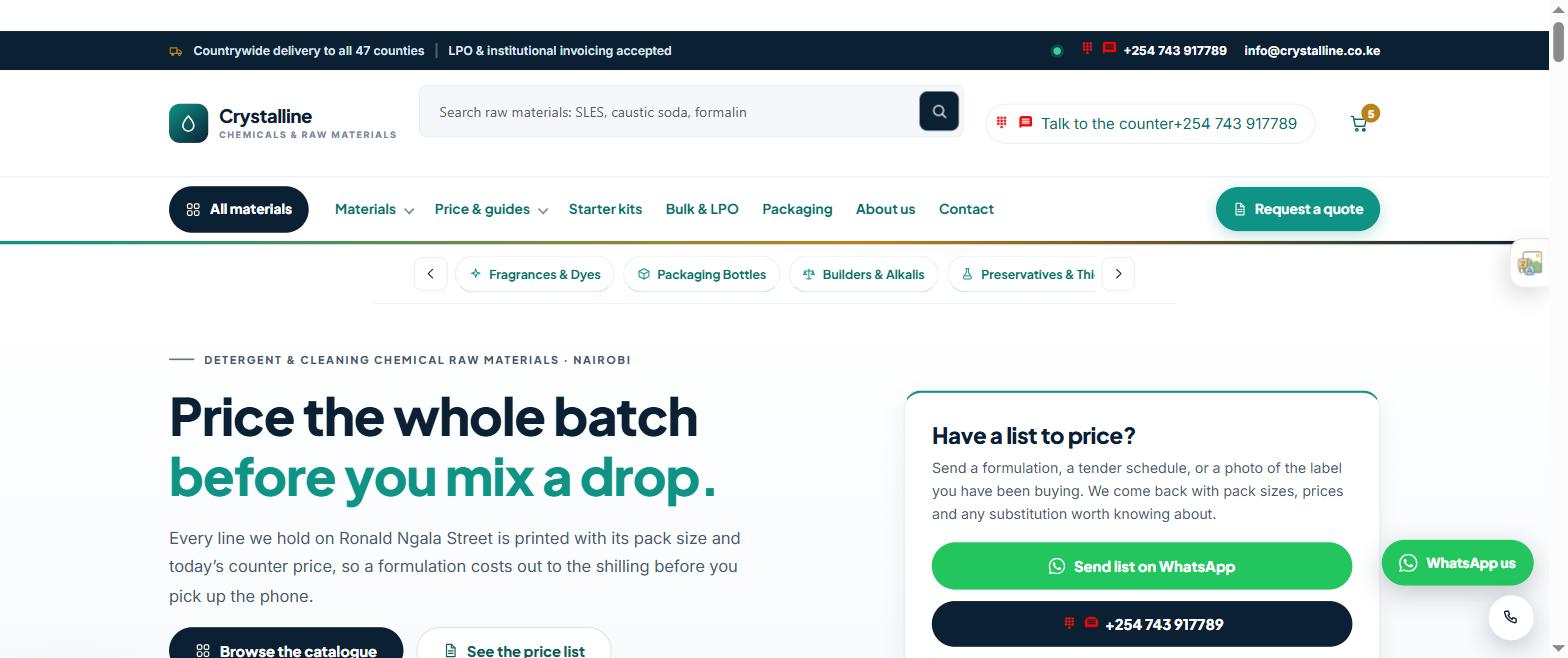
Here is one we built. Look at where the price sits, where the WhatsApp button sits, and how little you have to think about.
What it costs
A properly built shop starts around KSh 250,000. Product count, options, payment connections and how much catalogue work we do are the main variables. See our work for four live examples.
Google research found that 76 out of 100 people who search on a phone for something nearby visit a business within a day. Source: Think with Google.
Questions
WooCommerce or Shopify?
For most Kenyan businesses, WooCommerce. No monthly platform fee, no cut of each sale, full control of your data, and easier M-Pesa. Shopify is better if you want almost no maintenance and are happy with the recurring cost.
Can you connect M-Pesa?
Yes, including push to phone at checkout. You will need a Daraja account with Safaricom and we help you set it up.
I have 500 products in a spreadsheet.
We can load them. Cleaning the data before import is usually worth it, because that decides whether those pages can be found.
How long does a shop take?
Six to twelve weeks depending on the catalogue. Preparing products usually decides the timeline more than the build does.
Ecommerce websites questions, answered
How much does ecommerce websites cost in Kenya?
It depends on what you sell and how many pages you need. Our ecommerce websites work uses one all in model: month 1 to set up, month 2 on us, then a monthly fee.
Use the free price calculator for a real range in shillings in under 60 seconds.
How long does ecommerce websites take?
You get a live link in 7 days. That is the start, not the finish. We keep improving your ecommerce websites every week and you see what changed.
Why choose Growth Catalyst for ecommerce websites?
Every project is personally managed by Patrick Maina. He has 8+ years in competitive markets like the US, UK, Canada and Australia, 876 projects and 452 five star reviews.
We focus on one thing: getting you found and turning visitors into sales.
Do you start with Google Ads?
Not at first. Every number we show comes from organic search. We only run ads once your page already ranks and sells, because new pages pay more per click.

Start with a voice note
Say what you sell and what is not working. You get a price and a start date. If you do not need this, I will tell you that instead.